Blog Posts

Year 2, Week 3: Goals

My biggest area of growth I have experienced as a Vivero Fellow has been in the problem-solving area, especially when it comes to thinking about solutions when I am stuck or troubleshooting. I think that it’s because of all of the digital tools and trainings that I have done so far, alongside the work that I’ve done on last year’s digital project. I think that an area that I have room to improve on would be collaborating with others. I hope to continue improving on this front by getting more experience mentoring my peers, whether they be other fellows or students needing help with digital humanities. As part of my digital project this year, my lead has also suggested I work with students in his class, before they submit their projects to our archive/site, so this could be an additional opportunity for me to practice my peer mentoring and collaborating skills.

Personally, even though it may not be super close to what I am doing for my digital project, I would like to learn the digital tool Twine, and experiment around a little bit with it. Although the stories and narratives that my project lead and I will tell are going to be more spatially oriented, I do still think it’s useful and interesting to explore other mediums of storytelling and worldbuilding. I am especially interested in Twine because growing up I was always interested in both video game design and choose-your-own-adventure stories, and I feel like I would enjoy the chance to do both as part of my training. I also wouldn’t mind getting familiarized with TimelineJS as a supplement to my StoryMapJS work for the American Culture Site Map. Come to think of it, I wouldn’t mind getting familiarized with most tools.
Year 2, Week 2: Accessibility Refresher

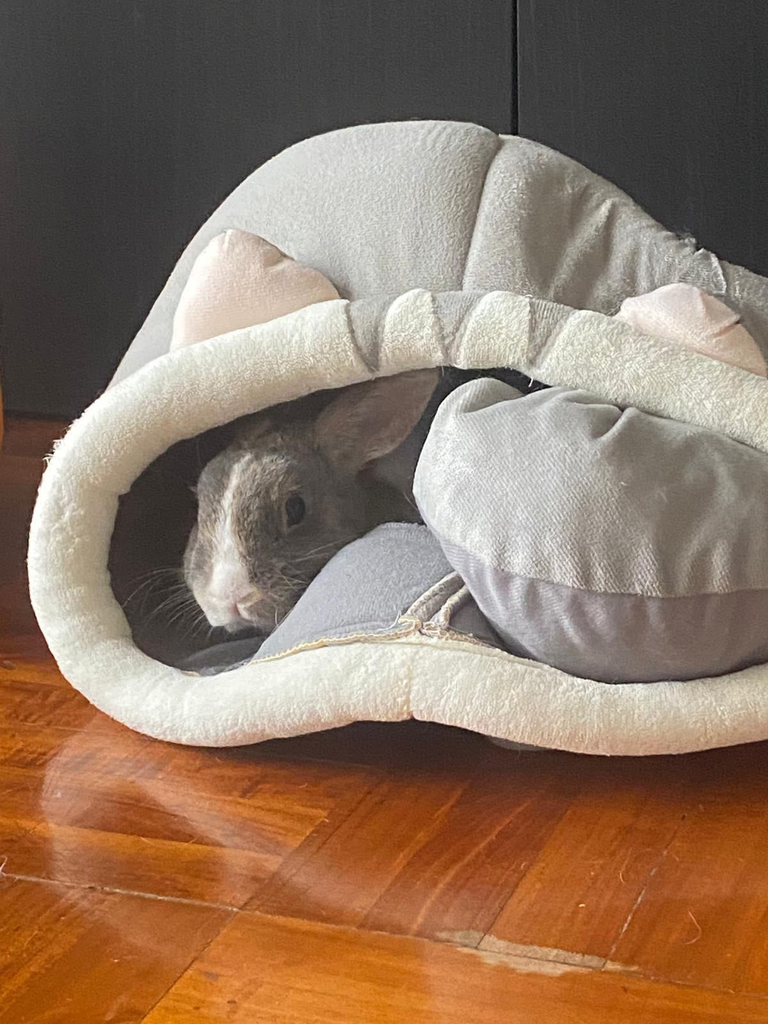
The only issue that popped up on my portfolio site was that I did not add alt-text to the photo of my pet rabbit, Snickers (you can see him on my about page). When I fixed this issue, the accessibility checker flagged the photo again, stating that the alt-text was not concise enough. After omitting some words, the issue was fixed. Moving forward, when I add images to my site (like more photos of Snickers), I will make sure to write helpful alt-text. That way, assistive technologies like screen readers can read the visual content aloud to users who may be blind or have low vision.

I anticipate the need for alt-text as I create the framework for my digital project. This is because my project, the American Culture Site Map, will be a showcasing of student projects, which will inevitably involve images, be it on the showcased projects themselves or the overarching map. There are other needs that I am keeping in the back of my mind, such as making sure the site has a decent amount of visual contrast, or the option to zoom in on text.

Snickers the rabbit in his hideout.

Year 2, Week 1: WordPress Revisited

I think the most important piece of advice I would give new Vivero Fellows specifically about learning on the fly is to give yourself grace and patience when you encounter difficulties, or when software doesn’t work the way you want it to. A large component of learning, including learning digital tools on the fly, consists of really having to sit and think about an optimal solution to a problem (like how best to categorize metadata), or different alternatives, or revisiting one’s initial approach. These things take time, and these things can be rather frustrating! It may seem difficult in the moment while you’re learning, but the time and frustration are very important to the learning process.

I guess another piece of (maybe unsolicited) advice I would give would be to not be afraid to ask for help. Sometimes you may simply be stuck having tried just about everything, and that would be the best time to get another set of eyes or hands to help you out. Who knows, maybe whoever you’re asking for help needs a fresh perspective on something as well.

Fall Retreat 2: Electric Boogaloo

  1. I’m most excited to get the chance to personalize my portfolio website, and to hopefully integrate more of the project that I work on in my portfolio than I did last year. I’m also looking forward to adding more applications and learning how to implement more digital tools as I go on to work on another digital humanities project.
  2. Something I’m still wondering about my WordPress site is the extent of things that I am able to add. Last year, the majority of what was on my portfolio were reflections on the digital tools I learned, rather than a demonstration of me showcasing the tools themselves (I would display the showcases specifically in Teams).
  3. I think my experience helping new fellows with WordPress is probably going to be similar to how I will help my peers learn how to use digital tools in the digital studio.

End of Semester Reflection

I think that the most important thing that I learned this year wasn’t any particular digital tool (even though Omeka was pivotal to my digital project), but rather the skill of learning new digital tools. I felt as if I got a good sense of how the weekly training modules worked, and I could compare my experience learning one tool or doing one of the trainings to another, and to develop a more general approach to teaching myself unfamiliar technologies or digital tools effectively and confidently in the future. One piece of advice I would give my past self about becoming a Vivero Fellow is to make sure you log your hours on your worklog and ADP, because even small tasks (such as composing emails, zoom calls with project lead, and writing this blog post, to name a few) will count as work time! Additionally, I would also caution my past self to not ‘rush’ through the trainings in the hopes that you would finish them as fast as possible such that you would have more time to work on other things during a drop-in shift. Instead, I would want to spend some time after completing the training, either by myself or with another fellow, to explore a digital tool further.

For my project this year, my project lead and I digitized an existing database of peer reviewed references (mainly scholarly articles) informing effective ways to teach STEM subjects. Our database is created, and we have implemented multiple systems to upload more references in the future. I think that the part of my work that I am most proud of is my growth when it comes to reading and engaging with the peer reviewed references. While most of my role in creating the database was technical, a large portion of the work at the beginning of the year consisted of me analyzing each reference before writing a short summary, similar to an abstract, and subsequently adding “tags” or keywords that corresponded to each reference (these would typically be words found frequently within each reference, or words noting specific pedagogical techniques or demographics within a study). The documentation that I have created for this project has been written to make the database sustainable and usable beyond my own involvement, as it clearly outlines how to add new references, apply consistent tagging practices ,and navigating the system for future site contributors.

Looking forward, I would be interested in exploring digital scholarship methods that expand on the work I did this academic year, particularly in areas like data visualization and text analysis (such as Voyant). I am particularly interested in how large collections of information (such as the articles I worked with) can be organized, analyzed, and presented in more interactive and accessible ways. As well as this, I’d also like to learn more about mapping tools and visualization platforms that could help indicate patterns or trends within data. And, as a physics major, I’m also interested in how digital tools can support further research and communication within STEM education, particularly in making research more accessible.

Best Practices for Science Education – Reflection

Coming into Grinnell, I really did not think that I would major in any of the sciences, let alone Physics, the one that I avoided the most in high school. To me (or at least me prior to coming to Grinnell), while the theory and concepts seemed interesting, the analytical rigor combined with all of the formulas and derivations seemed far too intimidating. However, with all that in mind, I still decided to enroll in a physics course in my second semester. Despite being an introductory course, the material was pretty tough, and I initially struggled. Be that as it may, working through my initial struggle ultimately made physics more rewarding, as persistence (and tons of textbook problems) allowed me to see and feel real growth, not just in how I understood the material I learned, but also how I approached learning itself.

As a Vivero fellow and digital scholar, my job itself doesn’t have me doing much in the way of solving or deriving physics equations, but I would be lying if I said that my work as a Vivero fellow was unrelated to my experience learning physics. If anything, struggling through physics reshaped how I thought about learning itself. Concepts that once felt overwhelming helped me better understand why certain approaches to teaching can either help or hinder student learning.

Through this project, and working with my super cool project lead, Minna Mahlab (which I’m not just saying because I know she’ll read this), I began to see teaching science as more than just transmitting information. Productive teaching requires careful attention to how students approach new material, such as how concepts are introduced, the role of intrinsic or extrinsic biases, or how space is made for struggle. By working with Minna to explore how science education research is conducted and communicated, I gained a deeper appreciation for the work that goes into shaping effective science education. Beyond the project itself, she was also a source of encouragement and perspective, offering (often snarky, but very useful) guidance that helped me navigate both academic challenges, and aspects of my personal life.

Overall, my experience with this Vivero project allowed me to connect my own personal academic growth with questions about how science is taught and learned by others. It gave me a deeper appreciation for the thought that goes into education, and it has shaped how I approach my own learning moving forward.

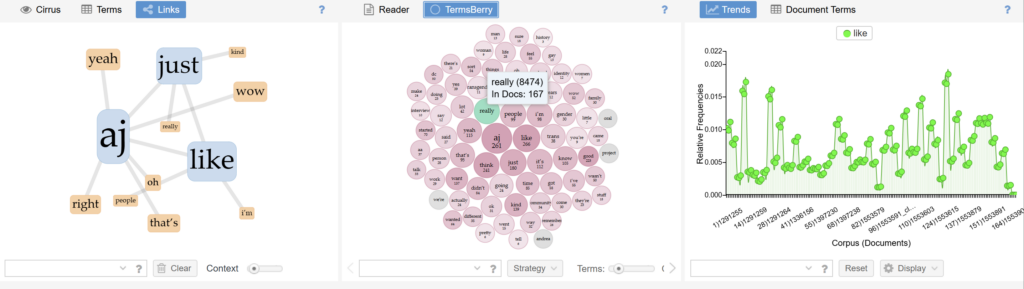
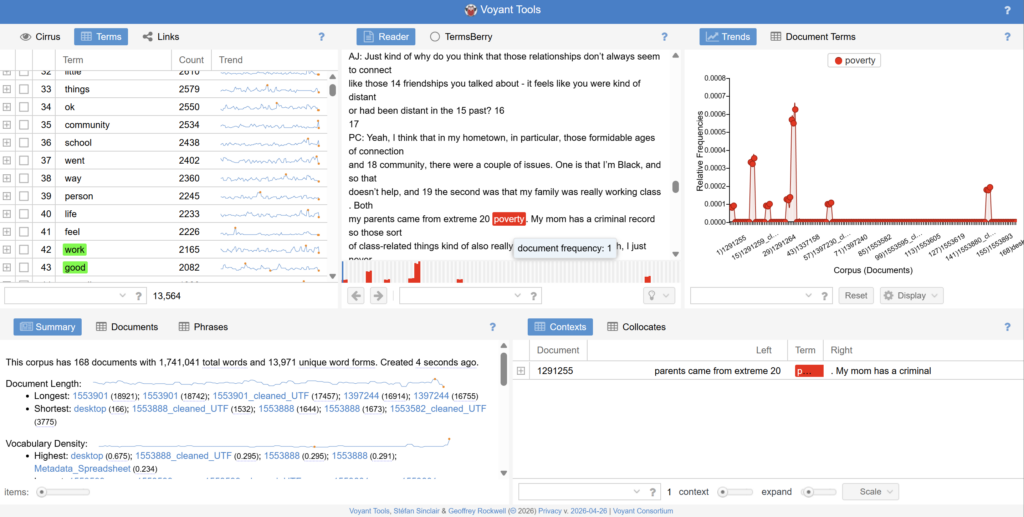
Voyant

Since there’s so many different options as to how one can edit, or use tools in Voyant, the initial process of learning how to navigate the tool was certainly more challenging for me compared to learning how to use Gale Digital Scholar Lab (which I’ll call Gale from here on out). Gale’s framework, and the steps one needs to take when using it (build, clean, then analyze) were much more straightforward from the outside looking in. As I previously said in my week 6 reflection when learning Gale for the first time, Gale helps you walk through the process of using it, which I feel makes it more approachable, and a better entry point into text analysis than Voyant for someone who’s just started out using these tools.

That being said, I did find that once I got the hang of using Voyant, I began to really enjoy using the tool, despite still being a little overwhelmed with everything you could do, and all their categories of analyzing text. I would still feel a little hesitant to say that I could 100% help someone use this tool, because there’s so much to learn, and I still need to figure out all of what Voyant is capable of.

March Reflection – Hiring/Interview Process

Overall I really enjoyed helping out with interviewing potential new Vivero fellows. It has only been roughly a year since I myself had my interview, so during the interviews I sat in for, I thought back to when I was in the interviewees shoes and my responses to the the questions that were asked, which if I remember correctly, were the same in 2025 and 2026. I remember liking how my interview was more conversational than confrontational, and I felt that it was the same way with the interviews I sat in for this year. One thing I found interesting was that all of the candidates I helped interview were all in their second or third year (two second-year students, and one third-year student respectively), while I applied to be a Fellow as a first year. As I will be a returning fellow next school year, I wonder how many rising second years will be in my cohort.

Putting Vivero on My Resume

I have learned many new skills as a Vivero fellow, and I have also had the opportunity to improve upon older skills that I may have used in the past, but hadn’t gotten the chance to frequently hone prior to becoming a Vivero fellow. Many of the new skills I have learned through Vivero have been technical, like the tools that we learned during our weekly trainings/deliverables from the first semester. Some existing skills that I have strengthened have been my communication skills (from peer mentoring and also working on my digital project with Minna), and troubleshooting. There were a lot of skills that I were aware of, but had not really thought too much about, as they seemed like the basic ‘building blocks’ for skills that I did give thought to. However, from this activity, and from putting my experience as a Vivero fellow on my resume/CV, I have become more aware of just how many skills I use as part of this job. One area that I am always trying to improve upon is anything to do with communication, as I am rather shy/introverted, and communicating my ideas, along with presenting them, has traditionally been intimidating to me. Even though I know that I have improved in that front, I know I still have a long way to go.

Week 2 – Portfolio Updates

This semester, I hope to explore Omeka more, specifically within the context of my digital project. I also would like to explore the different features in WordPress to make my site look nicer. Right now, I am pretty content with how my site looks, but I am curious as to what cool features/aesthetic aspects I can include in the future. I would also like to develop my documentation skills, as I did not hone them very much last semester. To achieve my goals, I will probably revisit old trainings from the first semester, and I will also most likely collaborate with other fellows during my shifts if I need help solving a problem.